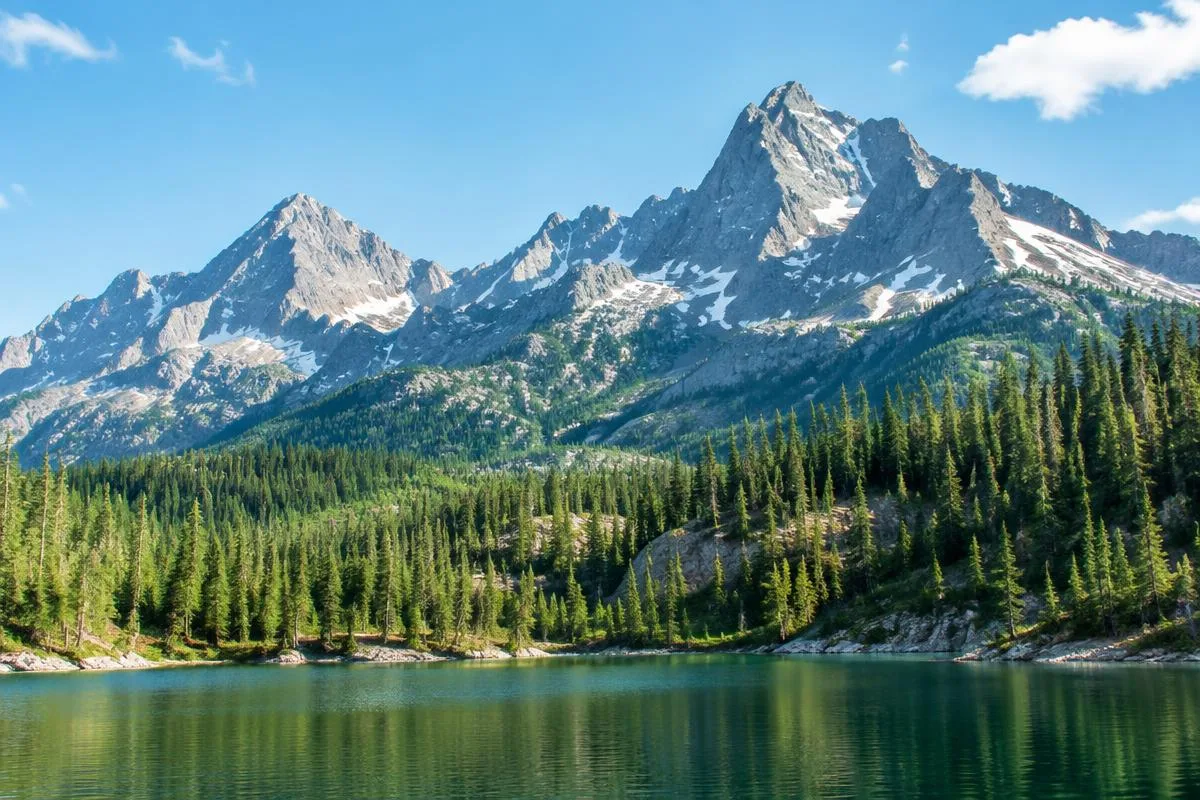
 AI-generated
Banff at a glance
- Best time
- Jun – Sep
- Warmest month
- Jul · 22°
- Sunshine a year
- 2,180 h
- Rain a year
- 657 mm
- Climate
- Mountain
- Time zone
- UTC−7 / UTC−6
- Elevation
- 1,388 m
Climate in Banff
Banff has a mountain climate: summers are fresh, winters cold and snowy. July is the warmest month with average highs of 22 °C, while December is the coolest at −8 °C. With around 2,180 hours of sunshine a year, Banff is moderately sunny; July is the sunniest month with 9.0 hours a day.
Holiday weather through the year
Weather in October
Holiday weather in October
Poor
Best time to visit: June – September
Best for skiing: March – April
Keep in mindSnow
A typical day in October
- Morning, 08:00: about -2°
- Midday, 13:00: about 5°
- Afternoon, 16:00: about 6°
- Evening, 20:00: about 3°
- Night, 23:00: about 0°
08:0418:52
Cold evenings: bring a warm jacket.
Estimated from the average high and low: coolest around sunrise, warmest in mid-afternoon.
Light for photos in October
- Golden hour
- Morning 07:43–08:49 · evening 18:06–19:12
- Blue hour
- Morning 07:30–07:43 · evening 19:12–19:25
Golden hour: the sun between 4° below and 6° above the horizon; blue hour: 6° to 4° below it. Times for the 15th of the month; mountains and clouds shift the light.
What is the weather like in Banff in October?
In October, Banff is cold: daytime highs average 7 °C, and nights often drop below freezing (−3 °C). Expect around 5 hours of sunshine a day. Rain falls on about 7 days, adding up to 33 mm. Snow falls on about 5 days. All in all, October is not an ideal month for a holiday in Banff.
More details for October
- Daylight
- 10 h 48 min08:04 – 18:52
- UV index
- 2 · lowclear sky, noon (estimate)All months
- Muggy days
- 0 daysdew point 18 °C or moreAll months
- Wind
- 14 km/haverage daily peakAll months
- Cloud cover
- 56 %on averageAll months
- Hot days
- 0 days30 °C or more
- Snow days
- 5 days1 cm or more of fresh snowAll months
- Time zone
- UTC−6America/Edmonton
How the score comes together
- Temperatureweight 50 %5 %
- Sunshineweight 20 %35 %
- Few rainy daysweight 30 %78 %
Each factor is rated from 0 to 100 % and weighted for the travel style “Mountain air”.
What to pack in October
- Warm jacket
- Hat, scarf & gloves
Sunshine hours in Banff
Average hours of bright sunshine per day, next to the length of the day. Tap a month to select it.
In October, the sun shines for about 5.1 of 10.8 hours of daylight in Banff, 47 % of the day.
Sunshine hours: estimated from radiation data (ERA5, 1996–2025) and calibrated against measured station values; no weather station is close enough here. Daylight is the time from sunrise to sunset on the 15th of the month.
UV index in Banff
How strong the sun is at noon, month by month, and how quickly unprotected skin burns.
- Clear-sky UV in October
- 2 · lowLittle protection needed; sunglasses on bright days.
The sun is strongest in June (UV 8).
Minutes until sunburn in October
- Very fair skin
- about 60 min
- Fair skin
- about 75 min
- Light brown skin
- about 110 min
- Olive skin
- over 2 h
Rough guide for unprotected skin at noon under a clear sky; clouds lengthen it, water, sand and snow shorten it. Sunscreen extends the time only partly.
Monthly values: clear-sky noon estimate from the sun's angle, ozone and altitude. UV today: Open-Meteo forecast.
Rain in Banff: rainy days and rainfall
A rainy day is a day with at least 1 mm of rain or snow; the amount is what falls in the whole month. Tap a month to select it.
In October, Banff has about 7 rainy days with 33 mm of rain in total.
Wind and clouds in Banff
How breezy and how cloudy Banff is through the year. Tap a month to select it on the whole page.
Wind
Typical daily peak of the wind in km/h: what the afternoon breeze usually reaches, not the gusts.
In October, the wind in Banff typically peaks at 14 km/h during the day: Beaufort 3, light breeze.
Clouds
Average share of the sky covered by cloud, day and night.
In October, cloud covers on average 56 % of the sky over Banff: variable cloud, with about 5.1 hours of sunshine a day.
Wind: mean daily maximum of the hourly wind 10 m above ground (ERA5, 1996–2025). Gusts are stronger, and the model grid of about 28 km smooths out local effects such as capes and valley winds. Clouds: mean total cloud cover of all layers over day and night (ERA5, 1996–2025). Thin high cloud counts as cover even when the sun still shines through.
Snow in Banff
When Banff is likely to be white: the chance of seeing snow during a week's stay, the days with fresh snow and how much falls. Tap a month to select it.
Snow calendar
- hardly any
- possible
- likely
- very likely
In October, Banff has about 5 days with at least 1 cm of fresh snow, 18 cm in total. The chance of seeing snow during a week's stay is 44 out of 100: possible. On the slopes at about 2,000 m, the ski season usually runs Mar – Apr.
Snow days bring at least 1 cm of fresh snow. Fresh snow comes from ERA5 snowfall (1996–2025) at the height of the place, not on the slopes above it; the snow chance also weighs whether the snow settles. An estimate from climate averages, not a snow report.
Climate through the year
Long-term monthly averages. Tap a month to see its details.
Nights and sleep in Banff
How warm the nights get in each month, from the mean night-time low. Tap a month for details.
- Frost below 0°
- Cold 0–8°
- Cool 8–15°
FrostOctober: nights around −3°. Heating and warm bedding are a must.
The coolest nights are in December (−15°), the warmest in July (10°). Nights fall below 8 °C on average from September to June, so the room should be heated.
Temperatures through the year
Average daytime high, night-time low and sea temperature per month.
| Month | Score | Day | Night | Sun | Rain days | Rain mm |
|---|---|---|---|---|---|---|
| JanuaryJan | 31 | −7° | −14° | 3.5 h | 5 | 16 |
| FebruaryFeb | 34 | −4° | −13° | 5.0 h | 5 | 18 |
| MarchMar | 33 | 1° | −9° | 5.9 h | 7 | 30 |
| AprilApr | 30 | 5° | −4° | 6.8 h | 10 | 52 |
| MayMay | 49 | 11° | 2° | 7.5 h | 13 | 83 |
| JuneJun | 67 | 16° | 6° | 7.8 h | 18 | 129 |
| JulyJul | 77 | 22° | 10° | 9.0 h | 15 | 99 |
| AugustAug | 77 | 21° | 10° | 7.7 h | 13 | 91 |
| SeptemberSep | 76 | 15° | 5° | 6.4 h | 10 | 61 |
| OctoberOct | 33 | 7° | −3° | 5.1 h | 7 | 33 |
| NovemberNov | 27 | −2° | −11° | 3.7 h | 6 | 26 |
| DecemberDec | 28 | −8° | −15° | 3.2 h | 5 | 19 |
Climate averages 1996–2025, not a forecast. Data: Copernicus ERA5 / ERA5-Land via Open-Meteo.com (CC BY 4.0), NOAA OISST, WMO 1991–2020 (NOAA NCEI), GeoNames (CC BY 4.0). Sources & licences
51.18° N, 115.57° W · 1,388 m · America/Edmonton
Best time to visit Banff
The best time to visit Banff is from June to September. Hiking and mountain trips are best from June to September, when the trails are largely free of snow. The wettest month is June with 129 mm of precipitation.
Banff through the seasons
How the weather changes over the seasons, with averages for each.
Banff in spring
Mar – May
Poor
- 1–11 °C by day
- 7 h of sun a day
- 30 rainy days in all
Banff in summer
Jun – Aug
Good
- 16–22 °C by day
- 8 h of sun a day
- 45 rainy days in all
Banff in autumn
Sep – Nov
Fair
- -2–15 °C by day
- 5 h of sun a day
- 23 rainy days in all
Banff in winter
Dec – Feb
Poor
- -8–-4 °C by day
- 4 h of sun a day
- 15 rainy days in all
Find your perfect month
Tell us what you like and we rate every month in Banff for you.
Your best months: July – August
Based on the climate averages; tap a month to see its details.
Compare two months in Banff
Pick two months to see how the weather differs. A tick marks the clearly better value; for temperatures it depends on your plans.
July has the better holiday weather in Banff: score 77 against 33. In July, days are 15 °C warmer than in October. July has 8 more rainy days. The sun shines 4 hours longer a day in July.
| Month | October | July |
|---|---|---|
| Weather score | 33 | 77better |
| Day high | 7° | 22° |
| Night low | −3° | 10° |
| Sunshine | 5.1 h | 9.0 hbetter |
| Rainy days | 7better | 15 |
| Rainfall | 33 mmbetter | 99 mm |
Based on the climate averages 1996–2025.
Which month for what?
Hiking & mountain trips
Jun – Sep
13–27 °C in the village, little snow
Snow
Sep – May
Snow on 2 or more days
Best for skiing
Mar – Apr
Estimated snow conditions on slopes at about 2,000 m, from snowfall, temperature and sunshine. A climate estimate, not a snow report.
Banff month by month
The typical weather for every month at a glance.
31January-7° · 4 h
In January, Banff is freezing cold: daytime highs average −7 °C, and nights often drop below freezing (−14 °C). The sun is scarce, with only about 4 hours a day. Precipitation, often as snow, falls on about 5 days, totalling 16 mm. Snow falls on about 4 days. All in all, January is not an ideal month for a holiday in Banff.
Banff in January34February-4° · 5 h
In February, Banff is freezing cold: daytime highs average −4 °C, and nights often drop below freezing (−13 °C). Expect around 5 hours of sunshine a day. Precipitation, often as snow, falls on about 5 days, totalling 18 mm. Snow falls on about 5 days. All in all, February is not an ideal month for a holiday in Banff.
Banff in February33March1° · 6 h
In March, Banff is freezing cold: daytime highs average 1 °C, and nights often drop below freezing (−9 °C). Expect around 6 hours of sunshine a day. Precipitation, often as snow, falls on about 7 days, totalling 30 mm. Snow falls on about 6 days. All in all, March is not an ideal month for a holiday in Banff.
Banff in March30April5° · 7 h
In April, Banff is cold: daytime highs average 5 °C, and nights often drop below freezing (−4 °C). The sun shines for around 7 hours a day. Rain is frequent, with about 10 rainy days and 52 mm in total. Snow falls on about 8 days. All in all, April is not an ideal month for a holiday in Banff.
Banff in April49May11° · 8 h
In May, Banff is cool: daytime highs average 11 °C, and nights cool down to about 2 °C. The sun shines for around 8 hours a day. Rain is frequent, with about 13 rainy days and 83 mm in total. Snow falls on about 6 days. All in all, May is a so-so month for a holiday in Banff.
Banff in May67June16° · 8 h
In June, Banff is mild: daytime highs average 16 °C, and nights cool down to about 6 °C. The sun shines for around 8 hours a day. It rains often – on about 18 days, adding up to 129 mm. Snow falls on about 2 days. All in all, June is a good month for a holiday in Banff.
Banff in June77July22° · 9 h
In July, Banff is warm: daytime highs average 22 °C, and nights cool down to about 10 °C. With around 9 hours of sunshine a day, there is plenty of sun. It rains often – on about 15 days, adding up to 99 mm. All in all, July is a good month for a holiday in Banff.
Banff in July77August21° · 8 h
In August, Banff is warm: daytime highs average 21 °C, and nights cool down to about 10 °C. The sun shines for around 8 hours a day. Rain is frequent, with about 13 rainy days and 91 mm in total. All in all, August is a good month for a holiday in Banff.
Banff in August76September15° · 6 h
In September, Banff is cool: daytime highs average 15 °C, and nights cool down to about 5 °C. Expect around 6 hours of sunshine a day. Rain is frequent, with about 10 rainy days and 61 mm in total. Snow falls on about 3 days. All in all, September is a good month for a holiday in Banff.
Banff in September33October7° · 5 h
In October, Banff is cold: daytime highs average 7 °C, and nights often drop below freezing (−3 °C). Expect around 5 hours of sunshine a day. Rain falls on about 7 days, adding up to 33 mm. Snow falls on about 5 days. All in all, October is not an ideal month for a holiday in Banff.
Banff in October27November-2° · 4 h
In November, Banff is freezing cold: daytime highs average −2 °C, and nights often drop below freezing (−11 °C). The sun is scarce, with only about 4 hours a day. Precipitation, often as snow, falls on about 6 days, totalling 26 mm. Snow falls on about 6 days. All in all, November is not an ideal month for a holiday in Banff.
Banff in November28December-8° · 3 h
In December, Banff is freezing cold: daytime highs average −8 °C, and nights often drop below freezing (−15 °C). The sun is scarce, with only about 3 hours a day. Precipitation, often as snow, falls on about 5 days, totalling 19 mm. Snow falls on about 4 days. All in all, December is not an ideal month for a holiday in Banff.
Banff in DecemberBanff compared
Put Banff side by side with another destination.
No destination found
Banff vs. Canmore
In October Canmore has the better holiday weather (score 39 vs. 33). During the day Canmore is 1 °C warmer than Banff.
| in October | Banff | Canmore |
|---|---|---|
| Holiday score | 33 | 39 |
| Daytime high | 7° | 8° |
| Sunshine | 5 h | 5 h |
| Rainy days | 7 | 7 |
| Best time | Jun – Sep | Jun – Sep |
Through the year
Canada in October: the best places
In October, Banff ranks 14 among the 31 nearest destinations in this country.
- Osoyoos (Okanagan)14°58
- 2Kelowna14°57
- 3Summerland13°54
- 4Penticton (Okanagan)14°54
- 5Calgary11°48
- 6Kamloops13°44
- 7Saskatoon10°41
- 8Regina10°40
- 14BanffThis page7°33
Planning a trip to Banff
Weather for your travel dates
Pick your arrival and length of stay, and we sum up the weather to expect.
Banff in the school holidays
How the weather suits the usual holiday periods. Dates vary by school and region, so each holiday uses the months it usually falls in.
Banff has its best school-holiday weather during the Easter holidays (ski score 88) and its weakest during the Christmas holidays (ski score 32).
- 88
Easter holidays
Mar – Apr
Excellent · ski conditionsBest holidays
- 4 °C by day
- 6.5 h of sun a day
- 9 rainy days a month
Good for: Skiing
- 53
May half-term
May – Jun
Fair
- 12 °C by day
- 7.6 h of sun a day
- 14 rainy days a month
Keep in mind: Snow
- 77
Summer holidays
Jul – Aug
Good
- 21 °C by day
- 8.2 h of sun a day
- 13 rainy days a month
Good for: Sightseeing & walks
- 33
October half-term
Oct
Poor
- 7 °C by day
- 5.1 h of sun a day
- 7 rainy days a month
Keep in mind: Snow
- 32
Christmas holidays
Dec – Jan
Poor · ski conditions
- −7 °C by day
- 3.4 h of sun a day
- 5 rainy days a month
Keep in mind: Snow
Based on the climate averages 1996–2025.
Getting there
Flying from
- Nonstop flight
- about 9 h
- Distance
- 7,080 km
- Time zone
- UTC−6
- Jet lag
- About 5 days (7 h west)
Rule of thumb for flying west: for a few days before, stay up a little later, and get afternoon and evening light at your destination.
Estimated from the straight-line distance: 30 minutes for take-off and landing plus 830 km/h cruising speed.
Frequently asked questions about Banff
When is the best time to visit Banff?
The best time to visit Banff is from June to September. That is when the holiday weather score, which combines temperature, sea, sunshine and rain, is highest.
What is the warmest month in Banff?
July is the warmest month, with average highs of 22 °C and nights around 10 °C. December is the coolest month at −8 °C.
When does it rain most in Banff?
The wettest month is June with 129 mm of precipitation. The driest month is January with 16 mm.
How many hours of sunshine does Banff get?
Banff gets around 2,180 hours of sunshine a year. The sunniest month is July with 9.0 hours a day; in December there are 3.2 hours a day.
What time zone is Banff in?
Banff uses the time zone America/Edmonton: UTC−7 in January and UTC−6 in July.
How long is the flight from London to Banff?
A nonstop flight from London to Banff takes about 9 h, for a straight-line distance of about 7,080 km.
Which school holidays are best for Banff?
Banff has its best school-holiday weather during the Easter holidays (ski score 88) and its weakest during the Christmas holidays (ski score 32). Holiday ratings (0–100): Easter holidays 88 (Ski), May half-term 53, Summer holidays 77, October half-term 33, Christmas holidays 32 (Ski).
Near Banff
Other destinations close by.
Places with a climate like Banff
Destinations whose weather through the year is closest to Banff's – good alternatives.